.svg)

Maximizing Affiliate Revenue: The Strategic Guide to Centralized Link Hubs
In the competitive landscape of 2026 digital marketing, the difference between a high-earning affiliate and a struggling creator often comes down to one factor: friction. Every extra click, every unoptimized URL, and every cluttered bio acts as a barrier between your audience's intent and your commission. 📉
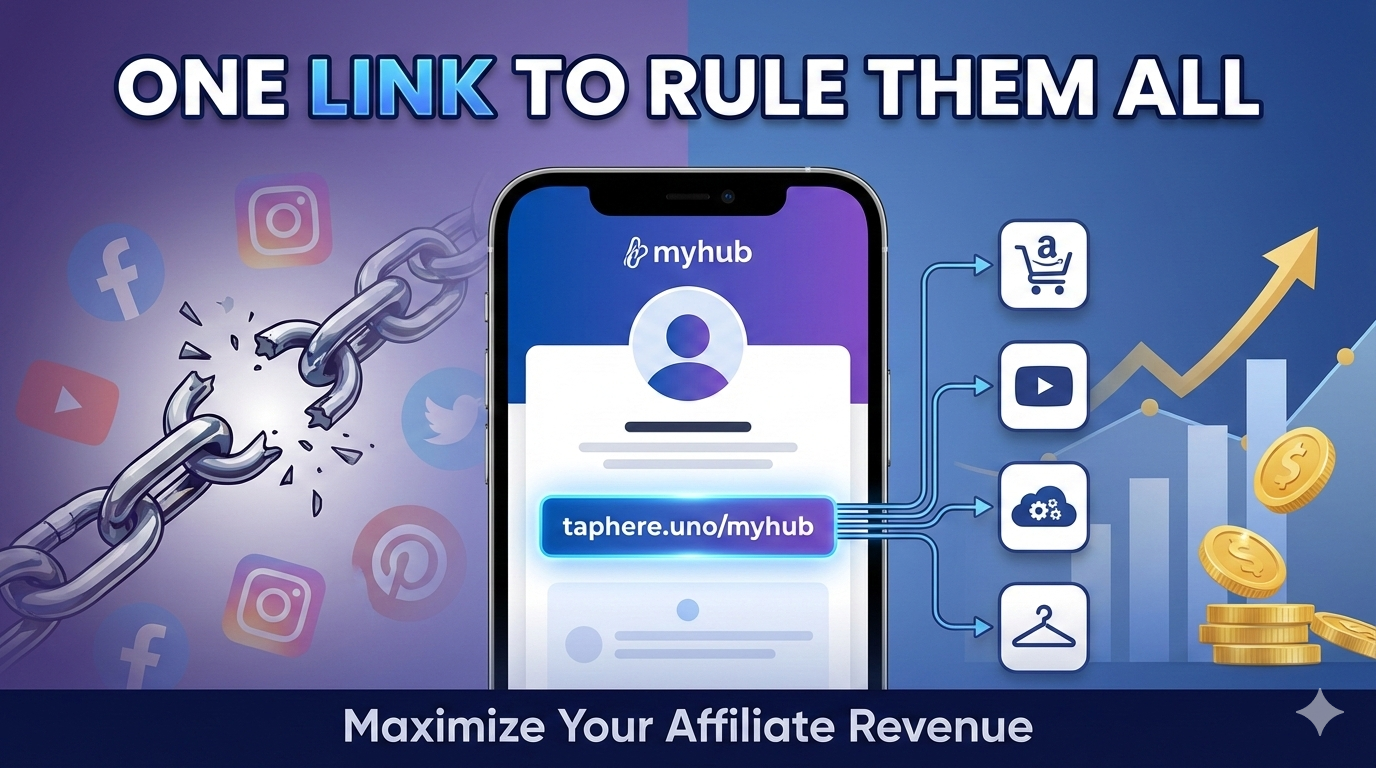
For the modern affiliate marketer, the traditional "link in bio" has evolved. It is no longer just a list of destinations; it is a revenue command center. Platforms like Instagram and TikTok still restrict users to a single external URL, creating a bottleneck for creators with diverse product portfolios. 🛠️
The solution is a centralized hub—a high-performance bridge page that streamlines the user journey. This guide explores how to transform a single link into a scalable affiliate empire, focusing on conversion psychology, strategic categorization, and professional branding. 🚀
1. The Strategic Shift: Beyond the "Messy Bio" 🧠
The "Messy Bio" syndrome—constantly swapping links or posting raw, unbranded URLs—is a conversion killer. To reach professional-level earnings, you must solve three core problems:
Eliminating Platform Friction 🧱
Social platforms are "walled gardens" designed to keep users on-site. When you force a user to leave the app, the experience must be seamless. A centralized hub ensures that no matter what content a user consumes—whether it’s a post from six months ago or a Reel from today—your recommendations remain accessible and organized.
Building Visual Trust 🛡️
In an era of heightened digital security, raw affiliate links (often long strings of alphanumeric code) look suspicious. By housing these links within a branded, professional interface, you transfer your personal brand’s "trust equity" to the product recommendation. 🤝
Longevity of Content ⏳
Viral content has a long tail. If a video goes viral three months after posting, but your bio link has since changed, you are leaving money on the table. A permanent hub ensures your "evergreen" content continues to monetize indefinitely.
2. Designing for High Conversion 🎨
Your affiliate hub is a landing page, and it should be optimized with the same rigors as a corporate sales funnel.
Professional Branding
Your hub must feel like a natural extension of your social presence.
Visual Consistency: Match your hex codes (colors) and typography to your main brand.
The "Value" Bio: Instead of a generic description, use a results-oriented bio. Example: "Curating the top 1% of productivity tools for remote founders." ✨
Intelligent Categorization 📁
Decision paralysis is real. If a user sees 40 buttons, they often click none. Organize your hub into logical silos:
The "Top 3": Highlight your highest-converting or most profitable offers at the top. ⭐
Niche Folders: Group links by category (e.g., "Gear," "Software," "Style").
Seasonal Collections: Create temporary sections for events like Black Friday or New Year's resolutions. 🏷️
3. The Anatomy of a High-Converting Button 🔘
Most affiliates fail because their "Call to Action" (CTA) is passive. To drive clicks, use the A.C.A. (Action, Context, Advantage) Formula:
Action: Use a strong, punchy verb (Grab, Secure, Claim, Unlock). 🏃♂️
Context: Clearly state what the product is (My 2026 Tech Stack).
Advantage: Give them a reason to click right now (20% Off + Bonus Guide). 💰
Weak CTA: "My Amazon Storefront"
Professional CTA: "⚡ Grab My Daily Productivity Gear (Exclusive Discount Applied)"
4. People Also Ask: The Professional’s FAQ 🙋♂️
How to earn $100 per day through affiliate marketing? 💵
Earning a consistent $100/day is the first major milestone. It requires shifting from "accidental sales" to "predictable traffic."
The Math: To earn $100, you either need 20 sales of a $5 commission product or 1 sale of a $100 commission product.
The Strategy: High-earners focus on Middle-of-Funnel (MoFu) content. These are "Comparison" or "Best Of" videos. When someone searches for "App A vs. App B," they are ready to buy. By providing the definitive answer and a direct link on your hub, you capture high-intent traffic. 📈
How to create a unique affiliate link? 🔗
A unique link is your digital fingerprint.
Network Registration: Sign up for reputable networks (Impact, PartnerStack, or Amazon Associates). 📋
Deep Linking: Don't just link to a homepage. Use "Deep Links" that go directly to the specific product page to reduce user friction.
Clean Presentation: Never post the raw tracking link. Embed it behind a professional button on your centralized hub. This masks the tracking code while keeping the attribution intact. 💎
How to make $10,000 a month with affiliate marketing? 🏦
Scaling to $10k/month requires moving away from one-off sales and toward Recurring Revenue and High-Ticket Offers.
Recurring SaaS: Promote software with monthly subscriptions. Earning 30% of a $50/month tool from 100 users creates a $1,500/month "floor" for your income. 🔄
The "Bridge" Strategy: Use your hub to offer a "Lead Magnet" (like a free PDF). Once they download it, you have their email. You can then market higher-priced affiliate products ($500+ commissions) via an automated email sequence. 📧
How many affiliate links can I have? 🔢
While there is no technical limit, there is a psychological limit. * Focus on the 80/20 Rule: 80% of your revenue will likely come from 20% of your links. 🧠
Curated Experience: Keep your primary view to 12 links or fewer. Use "Folders" to hide secondary recommendations. This maintains a clean, professional aesthetic that doesn't overwhelm the visitor. 🙅♂️
How to earn $500 per day? 💰
Reaching $500/day typically involves Paid Traffic Arbitrage or High-Ticket Ecosystems.
Ad Scaling: If your hub converts at 5%, you can afford to pay for traffic via Meta or Google Ads. If you spend $200 on ads to generate $500 in commissions, you have a scalable business model. 📈
Webinar Affiliates: Promote high-ticket masterclasses or coaching programs where commissions range from $500 to $1,000 per sale.
Who is the No. 1 earning app? 🏆
As of 2026, the landscape is diverse, but the top performers are:
TikTok Shop (Affiliate): Best for impulse-buy physical products. 🛍️
YouTube: The leader for high-ticket software and "Expert" recommendations. 📺
Amazon Associates: The global standard for conversion reliability. 📦
PartnerStack: The preferred choice for high-paying B2B and SaaS tools. 💼
5. Omnichannel Traffic Strategy 🚘
A hub is only effective if people visit it. In 2026, your strategy must be cross-platform:
Short-Form Video (TikTok/Reels): Use "Pattern Interrupt" hooks. Instead of "link in bio," say: "I've uploaded the full setup guide and the discount codes to the 'Tech' section of my hub." 📱
YouTube Long-Form: Use a pinned comment with your hub link. Refer to it as your "Resource Library." 🎥
Email & Newsletters: Include a "My Tools" section in every footer. This turns every sent email into a potential revenue event. ✉️
6. Data-Driven Optimization 🧪
Professional marketing relies on data, not guesswork. Use your hub's analytics to audit your performance monthly.
| Metric | Business Insight | Optimization Strategy |
|---|---|---|
| CTR (Click-Through Rate) | Are your CTAs enticing? | Test different button colors or action verbs. |
| Traffic Source | Where is your "highest value" audience? | Double down on the platform driving the most revenue. |
| Link Decay | Are old links still working? | Remove or update links with zero clicks over 30 days. |
7. Compliance and Professional Ethics ⚖️
Transparency is a requirement for long-term success. In 2026, global regulations (FTC, GDPR) mandate clear affiliate disclosures. 📜
A professional disclosure doesn't deter sales; it builds authority. Place a clear statement at the base of your hub:
"Disclosure: As an independent creator, I may earn a commission from purchases made through links on this page. I only recommend tools I have personally vetted to ensure they provide value to my audience." ✅
8. The 2026 Edge: NFC and Physical Taps 📱⚡
The "Tap" is the new click. Using a domain like taphere.uno allows you to bridge the physical-digital divide.
NFC Networking: Carry a digital business card or phone sticker. When you meet people at events, a simple tap brings them directly to your affiliate hub.
In-Person Influence: If you are a fitness coach or consultant, having a "Tap Here" point in your workspace allows clients to instantly access your recommended supplements or gear.
9. Conclusion: The Power of Simplification 🌟
Affiliate marketing in 2026 is no longer about who can post the most links; it’s about who can provide the best curation. By centralizing your offers into a single, professional hub, you provide a service to your audience while maximizing your own revenue potential. 📈
Stop sending your hard-earned traffic to messy, unoptimized destinations. Build a resource that reflects your brand's quality, simplifies the user journey, and turns every "tap" into a transaction. 🏆