.svg)

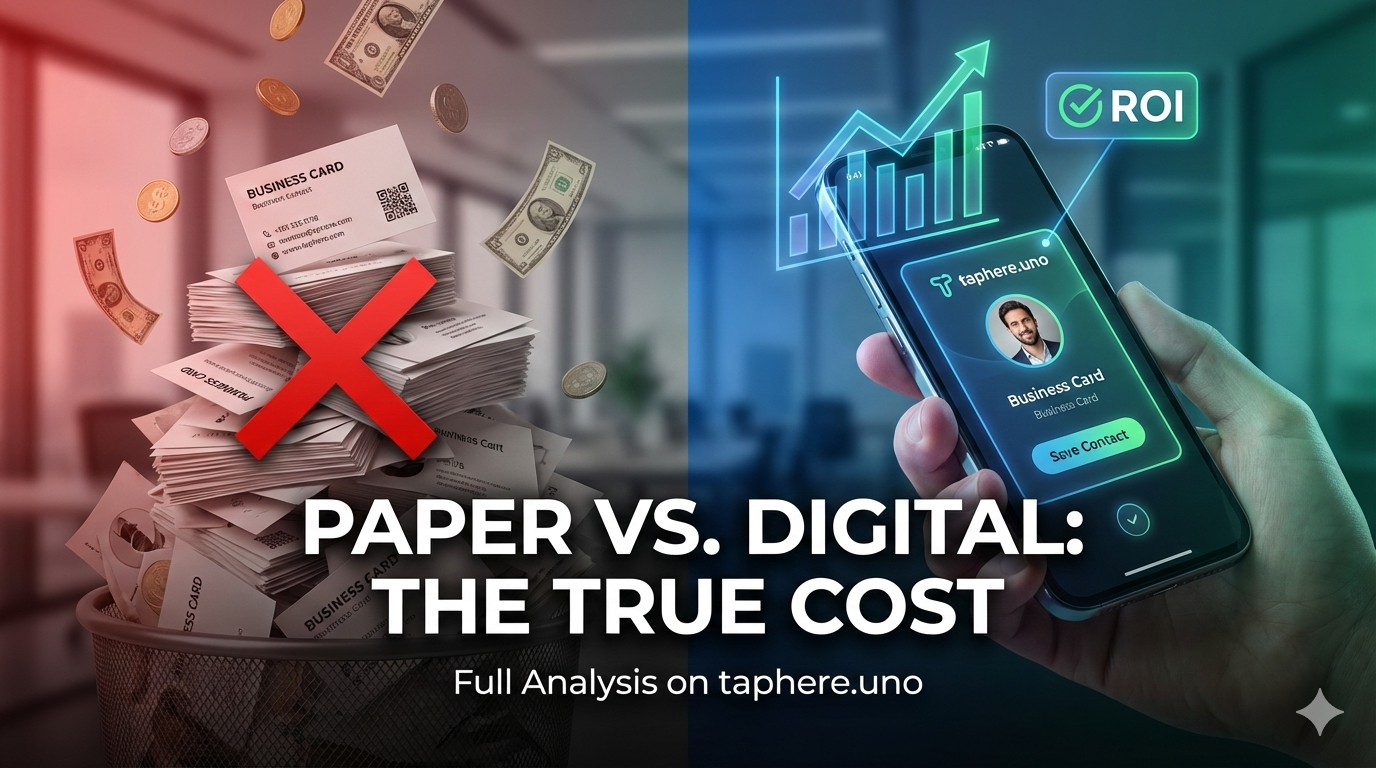
📉 Paper vs. Digital: The True Cost of Business Cards (2026 Edition)
In the high-stakes world of networking, your business card is often the first "product" a potential client or partner receives from you. But have you ever sat down to calculate what those little rectangles of cardstock are actually costing you?
As we move through 2026, the data is clear: the era of paper isn't just fading—it's becoming a financial and environmental liability. Let’s break down the true cost of business cards and why modern professionals are making the permanent switch to taphere.uno.
1. The "Visible" Costs: More Than Just Ink and Paper 💸
Most people look at the price of a box of 500 cards and think, "That’s a bargain." But the initial printing price is just the tip of the iceberg.
Unit Price Inflation: Between premium cardstock, specialized finishes, and shipping, a professional paper card in 2026 costs between $1.50 and $2.50 per unit.
The 88% Failure Rate: Statistics show that 88% of paper cards are thrown away within a week.
1 If you hand out 100 cards, 88 of them end up in the trash before next Monday.2 Recurring Fees: Every time you get a promotion, change your phone number, or update your brand's look, you have to toss your existing stock and pay for a full reprint.
2. The "Hidden" Costs: Time and Opportunity ⏳
The biggest costs of traditional networking are the ones that don't show up on an invoice.
Lost Leads: When you give someone a paper card, you are relying on them to manually type your info into their phone. Most people are too busy. A digital card with a "One-Tap Save" feature increases contact retention significantly.
Zero Analytics: With paper, you have no idea if your card was looked at once or shared with a CEO. You are networking in the dark.
The "Out of Stock" Moment: There is nothing less professional than saying, "Sorry, I just ran out of cards," at a major conference. A digital card is always in your pocket.
🔍 People Also Ask
Are digital business cards better than paper?
Yes. Digital cards are superior for three main reasons: Actionability (one-tap save to contacts), Analytics (tracking who clicks your links), and Flexibility (updating your info instantly without reprinting). While paper has a "tactile" feel, digital cards convert strangers into leads much faster.
How much does it cost to get 1000 business cards printed?
In 2026, a standard batch of 1,000 cards costs between $100 and $250. However, if you want "executive" quality (thick 32pt cardstock, foil, or textured finishes), that price can skyrocket to $500+. Remember, if your info changes next month, that entire investment is wasted.
Are digital business cards worth it?
Absolutely. Most digital business card platforms like taphere.uno offer a free tier or a low one-time cost for an NFC card. When you compare a one-time $30 investment to an annual $200+ reprinting habit, the digital card pays for itself within the first three months.
Which material is best for business cards?
Paper: Best for "throwaway" high-volume marketing (though eco-unfriendly).
Metal/Plastic: Durable and premium, but still suffers from static information.
NFC/PVC: The best material for 2026. A single PVC or Metal NFC card allows you to "tap" your info onto any phone, combining a premium physical feel with digital intelligence.
What is the average cost of 500 business cards?
On average, you can expect to pay $50 to $150 for 500 cards. This price varies based on the "GSM" (thickness) of the paper and whether you choose a matte or glossy finish.
What makes a business card look cheap?
A card looks "cheap" if it uses thin, flimsy paper, has low-resolution/blurry logos, uses outdated clip art, or—worst of all—has hand-written corrections because a phone number changed. A digital card avoids all of this by remaining crisp, high-def, and perfectly up-to-date.
📊 Side-by-Side: The Final Verdict
| Feature | Traditional Paper Card | taphere.uno Digital Card |
|---|---|---|
| Annual Cost | ~$100 - $300+ (Recurring) | Low One-time / Monthly |
| Update Capability | Must Reprint | Instant & Free |
| Lead Capture | Manual / Difficult | Automatic & One-Tap |
| Environmental Impact | High Waste | Eco-Friendly |
| Interactivity | Static Text | Videos, Portfolios, Social Links |
🎯 The Bottom Line
If you are still using paper business cards in 2026, you aren't just being "traditional"—you are actively losing money and missing leads. The "true cost" of a paper card is the opportunity cost of every contact that didn't save your number because the process was too slow.
By switching to taphere.uno, you ensure that your first impression is modern, professional, and—most importantly—permanent.
Stop throwing your money in the trash. Build your high-ROI digital card at