.svg)

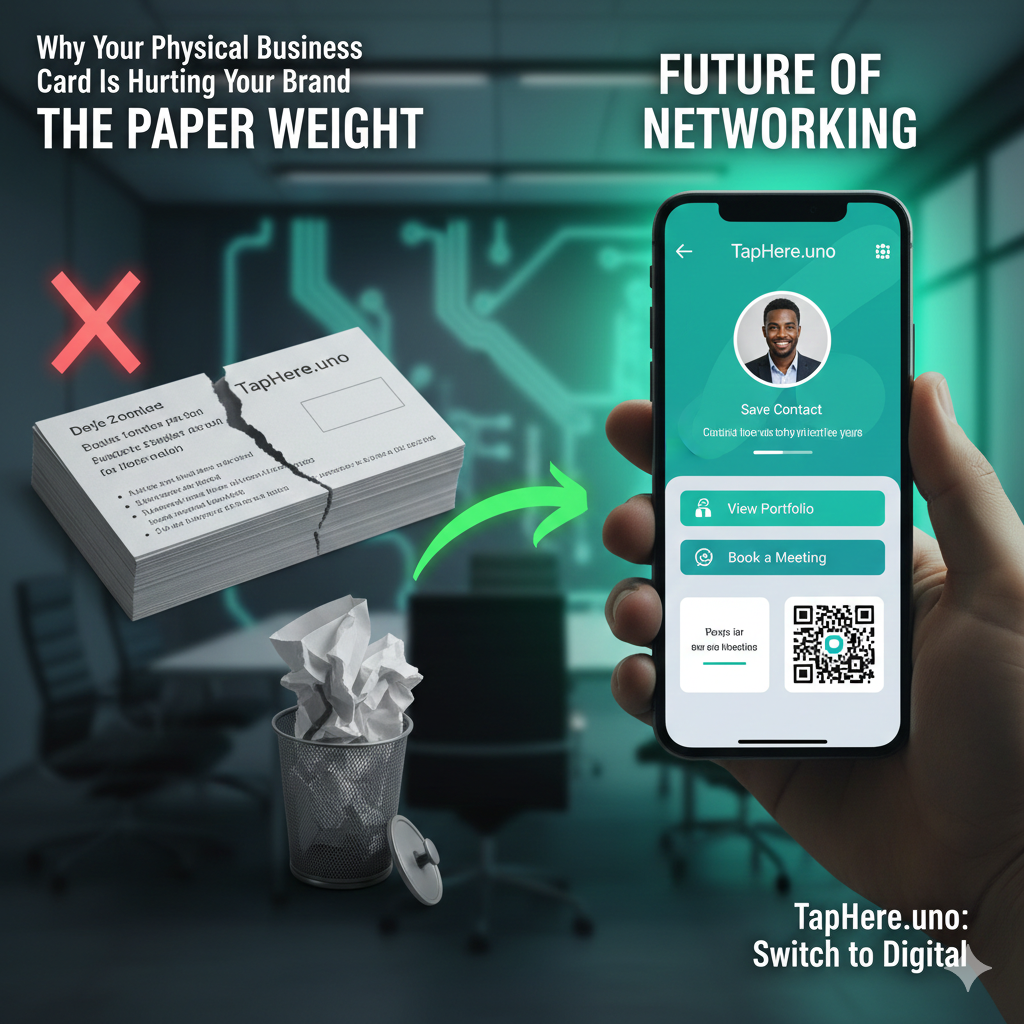
📉 The Paper Weight: Why Your Physical Business Card is Hurting Your Brand
It’s a classic scene: You meet a high-value prospect at a conference, you have a great conversation, and you end it by sliding a premium, cardstock business card across the table. You feel professional. You feel prepared.
But by the time that prospect gets to their hotel room, your card is likely at the bottom of a bag, buried under a stack of others, or—let's be honest—in the trash.
In 2026, relying on physical business cards isn't just "old school"—it’s actually creating a barrier between you and your next big deal. Here is why that little piece of paper is doing more harm than good to your professional brand. 🚫📇
1. The "Friction" Factor: You're Asking for Homework 📝
When you give someone a physical card, you are giving them a task. You are asking them to:
Manually type your name into their phone.
Carefully input your 10-digit phone number without a typo.
Correctly spell your complex email address.
Most people are too busy for that. By the time they have a free moment, the "spark" of your meeting has faded, and your card is forgotten. A digital solution like TapHere.uno removes this friction by allowing them to save your info with one tap.
2. Static Data in a Dynamic World 🔄
Your brand is constantly evolving. Maybe you just launched a new website, changed your job title, or updated your service pricing.
The Physical Problem: If your info changes, your 500 printed cards become instant litter. You either have to hand out incorrect info (which looks unprofessional) or pay for a total reprint (which is a waste of money).
The Digital Edge: With a dynamic hub like TapHere, you update your profile once, and your link/QR code stays the same. Your brand stays current in real-time.
3. The "Eco-Anxiety" Impression 🌿
In 2026, sustainability isn't just a buzzword; it’s a brand value. High-performing companies and Gen Z/Millennial decision-makers are increasingly conscious of environmental impact.
Handing out a plastic-coated or heavy-ink paper card can subtly signal that your brand isn't thinking about the future. Switching to a digital-first approach shows you are forward-thinking and environmentally responsible.
4. No Analytics = No Strategy 📊
A physical business card is a "black hole." Once it leaves your hand, you have no idea:
Did they ever look at it again?
Did they click your portfolio link?
Did they share your info with a colleague?
With TapHere.uno, you get a dashboard of data. You can see how many people scanned your code and which links they clicked. This data allows you to measure the ROI of your networking events.
5. Information Limitations 🛑
A business card is roughly 3.5 by 2 inches. That is not enough space to showcase your brand's true depth. You’re forced to choose between a cluttered design or leaving out important links like your LinkedIn, Instagram, or latest case study.
A digital hub allows you to showcase:
Video Greetings: Let them hear your voice again.
Social Proof: Direct links to your reviews.
Direct Booking: Let them schedule a call immediately.
🔍 People Also Ask
Is the business card dead?
The physical business card is dying, but the concept of exchanging contact info is more important than ever. The industry has shifted toward "Digital Business Cards" and NFC technology because they are more efficient and interactive.
Why are business cards so expensive?
Between premium paper, specialized finishes (like gold foil or embossing), and shipping, a set of 500 high-quality cards can cost over $100. When you factor in the cost of reprinting every time your info changes, a digital subscription is significantly more cost-effective.
How do I stop using paper business cards?
Start by creating a digital profile on a platform like TapHere.uno. You can save your unique QR code to your phone's lock screen or a digital wallet. The next time someone asks for your card, say, "I’ve gone paperless! Just scan this, and it’ll save my info directly to your phone." It’s a great conversation starter.
Will people think I'm unprofessional without a card?
Quite the opposite. In tech, sales, and creative industries, using a digital card marks you as an early adopter who values efficiency. It shows you respect the other person's time by making it easier for them to connect with you.
The Bottom Line 🎯
Your brand is modern, fast-moving, and professional. Your business card should be, too. Don't let a 15th-century technology (printing on paper) hold back your 21st-century career.
Stop hurting your brand with paper.