.svg)

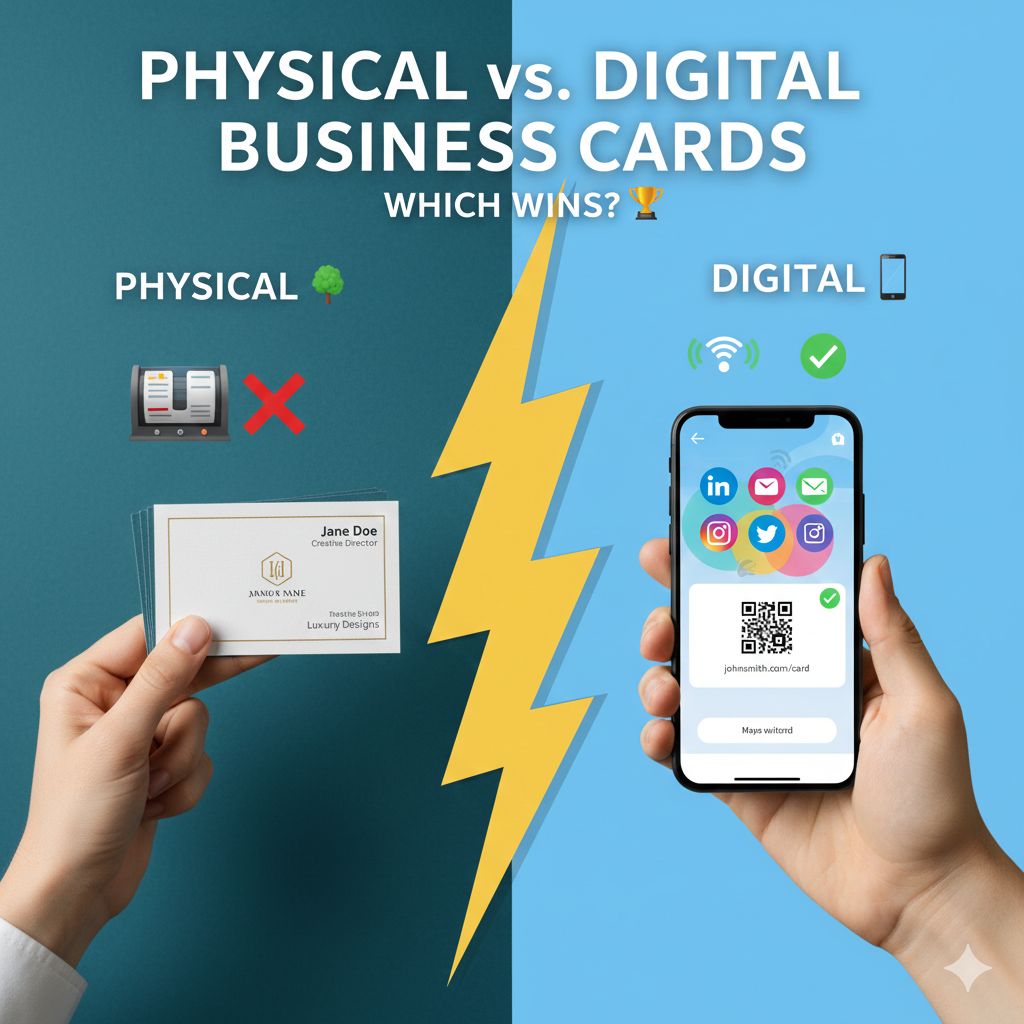
Physical vs. Digital Business Cards: Which Wins in Today's World? 💼📲
Remember the satisfying weight of a crisp, well-designed business card in your hand? For decades, it was the ultimate networking tool, a tangible piece of your professional identity. But in our increasingly digital age, a new contender has emerged: the digital business card.
So, which reigns supreme in the quest to make a lasting impression and drive connections? Is it the timeless tactile experience or the sleek, eco-friendly efficiency of digital? Let's break down the pros and cons to see which one truly wins for modern professionals. 🥊
The Classic Contender: Physical Business Cards 📇
For a long time, the physical card was the way to exchange contact information. It's more than just paper; it's a statement.
Pros of Physical Business Cards:
Tangibility & Professionalism: There's something inherently professional about handing over a physical card. It feels solid, real, and signals a preparedness for business. It can be a mini work of art, showcasing your brand's aesthetic with unique finishes, paper stock, or letterpress. ✨
Memorable Sensory Experience: The look, the feel, even the subtle scent of a premium card can create a lasting impression. It's a tactile reminder of your interaction.
No Tech Required: Simple, universal, and instantly understandable. No need for QR codes, NFC, or app downloads. Just hand it over! 🙌
Easy to Distribute: Perfect for conferences, trade shows, or chance encounters. You can leave them in stacks, hand them out quickly, and they serve as an immediate takeaway.
Traditional Trust: Many still view a physical card as a sign of established business and credibility, especially in more conservative industries.
Cons of Physical Business Cards:
Environmental Impact: Millions are printed and often discarded, contributing to waste. 🌳
Limited Information: Space is finite. You can only fit so much on a 3.5 x 2-inch rectangle.
Outdated Information: If your number, email, or job title changes, your entire batch of cards becomes obsolete. Expensive to reprint! 💸
Easy to Lose or Forget: Cards can get lost in wallets, pockets, or forgotten on desks. How many have you personally misplaced?
No Analytics: You have no idea if your cards are actually leading to follow-ups or conversions.
The Modern Marvel: Digital Business Cards (NFC, QR, Link-in-Bio) 📲
Digital cards come in many forms, from simple link-in-bio pages to advanced NFC-enabled cards. They offer a fresh, dynamic approach to networking.
Pros of Digital Business Cards:
Eco-Friendly: Zero paper waste! A huge win for the environment and a great talking point. 🌍💚
Always Up-to-Date: Change your information once, and it updates everywhere. No reprinting costs, ever.
Rich Information & Media: Link directly to your portfolio, social media, videos, testimonials, booking pages, and more. The possibilities are endless! 🤩
Trackable Analytics: Many digital card platforms offer analytics, so you can see views, clicks, and even where your contacts are coming from. This is invaluable for refining your networking strategy.
Interactive & Engaging: QR codes can lead to dynamic content, and NFC cards offer a "tap-to-share" experience that feels futuristic and impressive.
Never Run Out: You'll never be caught without a card again! As long as you have your phone, you have your card. 🥳
Cost-Effective (Long-Term): While there might be an initial setup cost for a premium platform or NFC card, you save on continuous printing expenses.
Cons of Digital Business Cards:
Requires Technology: Both parties need a smartphone or a device with internet access. What if someone has an older phone or poor signal? 📶
Learning Curve: Some people (especially those less tech-savvy) might be hesitant or confused by QR codes or NFC taps.
Impersonal Feeling: Some argue that it lacks the personal touch of a physical exchange.
Platform Dependency: If your chosen digital card platform goes down or changes its service, it could impact your ability to share.
Data Privacy Concerns: Sharing too much personal information through various links can raise privacy questions for some.
The Verdict: Is There a Clear Winner? 🏆
Honestly, it's not a simple knockout. The "winner" largely depends on your industry, target audience, and personal preference.
For highly traditional industries (e.g., finance, law, government), a physical card might still carry more weight and be expected.
For creative, tech, or modern service-based industries, a digital card showcases innovation and efficiency, aligning perfectly with your brand.
For general networking, a hybrid approach is often the most powerful.
The Hybrid Approach: The Smartest Strategy 🧠
Why choose when you can have the best of both worlds? Many professionals are now using a dual strategy:
A few high-quality physical cards: For those crucial, high-impact meetings where a tangible exchange is important. These cards might even have a QR code on the back leading to your digital profile.
A primary digital card: For everyday networking, impromptu meetings, and when you want to share a wealth of information effortlessly.
This way, you cater to all preferences and are prepared for any networking scenario.
❓ Frequently Asked Questions (FAQ)
Are digital business cards better than paper?
In terms of sustainability, cost-efficiency, and data depth, yes. Digital cards allow you to share more than just a phone number—you can share videos, portfolios, and booking links. However, "better" is subjective; in high-stakes traditional environments, a premium paper card still offers a unique tactile prestige that digital can't replicate.
Are physical business cards worth it?
Yes, but only if they are high-quality. A cheap, flimsy paper card can actually hurt your brand. Physical cards are worth it for face-to-face networking, trade shows, and industries where personal touch and physical reminders are valued.
What is the success rate of business cards?
Statistics show that for every 2,000 cards handed out, a company’s sales increase by an average of 2.5%. However, nearly 88% of paper cards are thrown away within a week. This is why many are moving to digital—it ensures your contact info lands directly in a client's phone, not the trash.
Why is digital better than paper?
Digital is superior for real-time updates. If you change your office location or phone number, you don't have to throw away 500 cards. Additionally, digital cards offer analytics, showing you exactly how many people clicked your links—something paper simply cannot do. 📈
What type of material is best for business cards?
For physical cards, a heavy cardstock (16pt or higher) is standard for a professional feel. If you want to stand out, materials like wood, metal, or recycled "seed paper" (which can be planted) are becoming popular for high-end branding.
Are 100% plastic cards good?
Plastic cards are extremely durable and waterproof, making them great for rugged environments. However, they are often difficult to write on (a common habit for networkers) and are not environmentally friendly unless made from recycled PVC. Many people now prefer NFC-enabled plastic cards, where you only ever need one card to tap against phones. 💳
What are the advantages and disadvantages of digital business?
Advantages: Global reach, lower overhead costs, 24/7 availability, and the ability to scale quickly using automation.
Disadvantages: High competition, dependency on technology/internet, and the challenge of building "human trust" through a screen rather than a handshake.
The Final Verdict: Which One Should You Choose? 🏆So, in the battle of Physical vs. Digital Business Cards, who truly wins?
The truth is, the "winner" isn't a product—it’s a strategy. If you operate in a traditional, high-touch industry like luxury real estate or law, the tactile elegance of a premium physical card is still a powerful status symbol. However, if you are a modern creator, tech professional, or eco-conscious entrepreneur, a digital business card is an essential tool for scaling your reach and tracking your networking ROI.